Nicolas Caytuiro
Affiliations: University of Chile, National Center for Artificial Intelligence (CENIA)
Av. Beaucheff 851
8370458 Santiago, Chile
West Building 208
I am developing a symmetry-aware framework for 3D generative models.
Current focus: 3D generative models and geometry processing.
I am a second-year Computer Science PhD student at the University of Chile, advised by Ivan Sipiran (He is super nice!). My research focuses on deep learning and 3D computer vision, particularly generative models and their applications. Currently, I am working on preserving structural priors in 3D generative models, specifically symmetry.
I am the co-founder of the Shape Vision Lab at the University of Chile and an affiliated PhD student at the National Center for Artificial Intelligence CENIA, Santiago, Chile.
News
| Aug 29, 2025 | We were present at the III Graduate Symposium, organized by the Faculty of Physical and Mathematical Sciences at the University of Chile |
|---|---|
| Aug 04, 2025 | Nicolas Caytuiro's Doctoral Qualifying Exam |
| Jun 22, 2025 | We are excited to announce the official launch of the Shape Vision Lab website 🚀! |
Selected Publications
- PreprintSymmetrization of 3D Generative Models
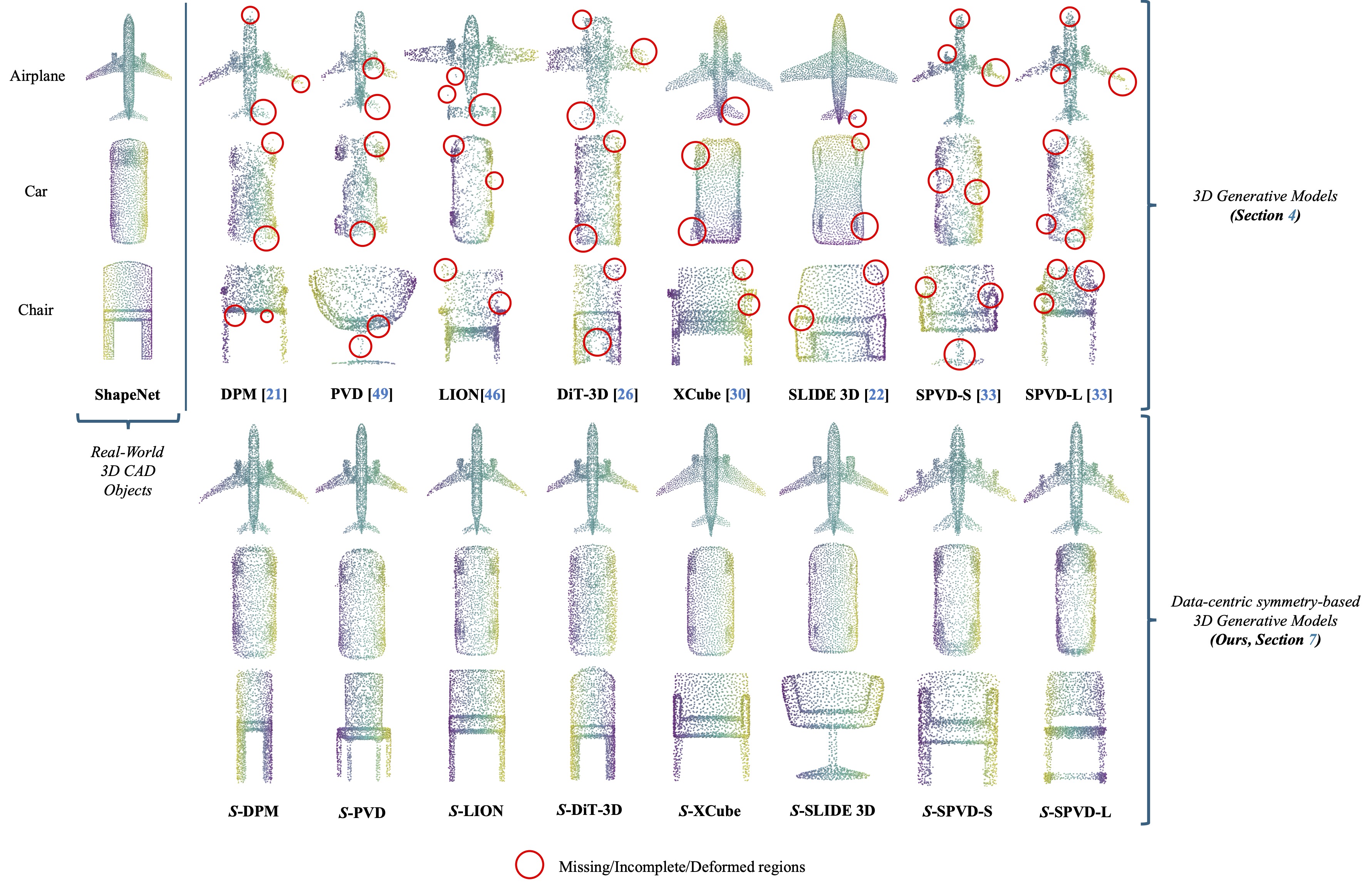
Nicolas Caytuiro and Ivan SipiranarXiv preprint arXiv:2512.18953, Dec 2025We propose a novel data-centric approach to promote symmetry in 3D generative models by modifying the training data rather than the model architecture. Our method begins with an analysis of reflectional symmetry in both real-world 3D shapes and samples generated by state-of-the-art models. We hypothesize that training a generative model exclusively on half-objects, obtained by reflecting one half of the shapes along the x=0 plane, enables the model to learn a rich distribution of partial geometries which, when reflected during generation, yield complete shapes that are both visually plausible and geometrically symmetric. To test this, we construct a new dataset of half-objects from three ShapeNet classes (Airplane, Car, and Chair) and train two generative models. Experiments demonstrate that the generated shapes are symmetrical and consistent, compared with the generated objects from the original model and the original dataset objects.
@article{Caytuiro2025Symmetrization, title = {Symmetrization of 3D Generative Models}, author = {Caytuiro, Nicolas and Sipiran, Ivan}, journal = {arXiv preprint arXiv:2512.18953}, %location = {}, volume = {}, issue = {}, pages = {}, numpages = {}, year = {2025}, month = dec, publisher = {}, doi = {}, } - Preprint3D Shape Generation: A Survey
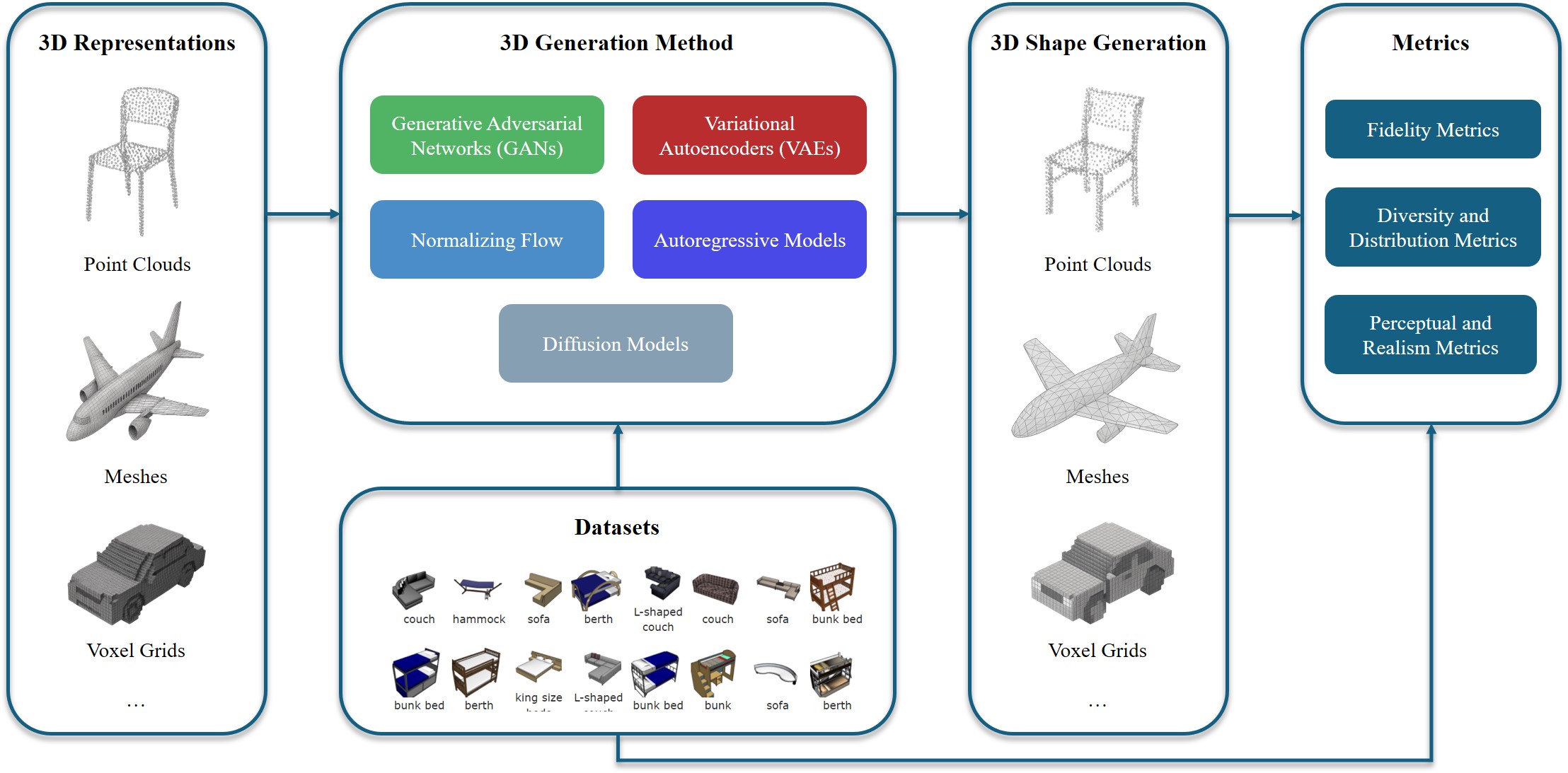
Nicolas Caytuiro and Ivan SipiranarXiv preprint arXiv:2506.22678, Jun 2025Recent advances in deep learning have significantly transformed the field of 3D shape generation, enabling the synthesis of complex, diverse, and semantically meaningful 3D objects. This survey provides a comprehensive overview of the current state-of-the-art in 3D shape generation, organizing the discussion around three core components: shape representations, generative modeling approaches, and evaluation protocols. We begin by categorizing 3D representations into explicit, implicit, and hybrid setups, highlighting their structural properties, advantages, and limitations. Next, we review a wide range of generation methods, focusing on feedforward architectures. We further summarize commonly used datasets and evaluation metrics that assess fidelity, diversity, and realism of generated shapes. Finally, we identify open challenges and outline future research directions that could drive progress in controllable, efficient, and high-quality 3D shape generation. This survey aims to serve as a valuable reference for researchers and practitioners seeking a structured and in-depth understanding of this rapidly evolving field.
@article{Caytuiro20253DShapeGen, title = {3D Shape Generation: A Survey}, author = {Caytuiro, Nicolas and Sipiran, Ivan}, journal = {arXiv preprint arXiv:2506.22678}, %location = {}, volume = {}, issue = {}, pages = {}, numpages = {}, year = {2025}, month = jun, publisher = {}, doi = {}, } - JournalStrengthening Digital Security through a Hybrid Encryption Algorithm for Messages on WhatsAppBenjamĂn Maraza-Quispe, VĂctor Hugo Rosas-Iman, Ramiro Max Solorzano-Bernuy, Leonor Casa-Zeballos, Miguel Angel Ttito-Suaña, and 4 more authorsSN Computer Science, May 2025
The primary objective of this study is to develop a cryptographic algorithm that integrates the Caesar and Vernam encryption methods, further secured through key encryption using a Hash function, aimed at enhancing message security in communication channels like WhatsApp ChatBot. The methodology involved designing and implementing the algorithm within a WhatsApp ChatBot to encrypt and decrypt messages directly within the platform, thereby demonstrating its practicality in real-world applications. Comparative analysis was conducted to evaluate the algorithm’s performance against other cryptographic methods, revealing a substantial improvement in data security. Specifically, the proposed approach showed superior resistance to unauthorized access and cryptographic attacks, outperforming methods such as ROT13 combined with Vernam and Stream Cipher, or modified Caesar techniques. The results also confirmed the algorithm’s capacity to protect message integrity and confidentiality effectively, addressing the challenges of secure digital communication. In conclusion, the findings validate the potential of the proposed algorithm as a robust solution for safeguarding data in messaging platforms. However, to fully explore its scalability and practical deployment, further research involving detailed simulations, real-world testing, and applicability in broader information security contexts is recommended. This underscores the importance of continuous innovation in cryptographic methods to enhance digital security and protect sensitive communications on platforms like WhatsApp.
@article{Caytuiro2025Strengthening, title = {Strengthening Digital Security through a Hybrid Encryption Algorithm for Messages on WhatsApp}, author = {Maraza-Quispe, BenjamĂn and Rosas-Iman, VĂctor Hugo and Solorzano-Bernuy, Ramiro Max and Casa-Zeballos, Leonor and Ttito-Suaña, Miguel Angel and Feliciano-Yucra, Giuliana and Martinez-Lopez, Atilio Cesar and Quispe-Flores, Lita Marianela and Caytuiro, Nicolas}, journal = {SN Computer Science}, %location = {}, volume = {6}, issue = {5}, pages = {}, numpages = {}, year = {2025}, month = may, publisher = {}, doi = {https://doi.org/10.1007/s42979-025-04007-z}, } - JournalOptimizing Attendance Management in Educational Institutions Through Mobile Technologies: A Machine Learning and Cloud Computing ApproachNicolas Caytuiro, BenjamĂn Maraza-Quispe, Eveling Gloria Castro-Gutierrez, Karina Rosas-Paredes, Jose Alfredo Sulla-Torres, and 2 more authorsInternational Journal of Interactive Mobile Technologies, May 2024
The primary goal of the study is to optimize and streamline the attendance recording and monitoring process for learning sessions by leveraging advanced technologies such as machine learning and cloud computing. The methodology employed is based on the extreme programming (XP) project management approach. Throughout its phases, the entire implementation process of the application, from conception to launch, is described in detail. Firebase is used as the database manager to ensure the efficiency and security of student information and attendance records. Additionally, the Firebase machine learning kit is used to verify attendance registration through QR codes. The application was tested with fifth-year high school students from an educational institution. The user interface has been designed to be attractive, intuitive, and easy to use for both teachers and students. The study results demonstrate that the use of this application significantly reduces the time spent on attendance recording compared to traditional methods. There has been a high level of satisfaction and acceptance of the “ASYS” application among teachers and students. In conclusion, this study has successfully implemented a mobile application that revolutionizes attendance recording and monitoring in educational institutions. It harnesses the power of machine learning and cloud computing to enhance efficiency and the user experience.
@article{Caytuiro2024Optimizing, title = {Optimizing Attendance Management in Educational Institutions Through Mobile Technologies: A Machine Learning and Cloud Computing Approach}, author = {Caytuiro, Nicolas and Maraza-Quispe, BenjamĂn and Castro-Gutierrez, Eveling Gloria and Rosas-Paredes, Karina and Sulla-Torres, Jose Alfredo and Alcázar-Holguin, Manuel Alfredo and Choquehuanca-Quispe, Walter}, journal = {International Journal of Interactive Mobile Technologies}, %location = {}, volume = {18}, issue = {12}, pages = {}, numpages = {}, year = {2024}, month = may, publisher = {}, doi = {https://doi.org/10.3991/ijim.v18i12.46917}, } - JournalAnnotated Peruvian Banknote Dataset for currency recognition and classificationNicolas Caytuiro, Jackeline Melady Peña-Alejandro, Eveling Gloria Castro-Gutierrez, Jose Sulla-Torres, and Benjamin Maraza-QuispeData in Brief, Dec 2023
The real-time detection of multinational banknotes remains an ongoing research challenge within the academic community. Numerous studies have been conducted to address the need for rapid and accurate banknote recognition, counterfeit detection, and identification of damaged banknotes. State-of-the-art techniques, such as machine learning (ML) and deep learning (DL), have supplanted traditional digital image processing methods in banknote recognition and classification. However, the success of ML or DL projects critically hinges on the size and comprehensiveness of the datasets employed. Existing datasets suffer from several limitations. Firstly, there is a notable absence of a Peruvian banknote dataset suitable for training ML or DL models. Second, the lack of annotated data with specific labels and metadata for Peruvian currency hinders the development of effective supervised learning models for banknote recognition and classification. Lastly, datasets from different regions may not align with the unique characteristics, design, and security features of Peruvian banknotes, limiting the accuracy and applicability of models in a Peruvian context. To address these limitations, we have meticulously curated a comprehensive dataset comprising a total of 9,315 images of Peruvian banknotes, encompassing both old and new denominations from 2011 (old) and 2019 (new). The Peruvian banknote dataset includes denominations of 10, 20, 50, and 100 Peruvian soles. Importantly, as indicated by, both the 2011 and 2019 families of banknotes are currently in circulation, further enhancing the dataset’s relevance for real-world applications in currency recognition and verification. This dataset serves as a vital resource for addressing the challenges in real-time multinational banknote detection. By offering a comprehensive collection of images of Peruvian banknotes, both old and new, this dataset fills a critical gap in the field of banknote recognition. Researchers can utilize it to train and evaluate advanced machine learning and deep learning models, ultimately enhancing the accuracy of banknote processing systems.
@article{Caytuiro2023Annotated, title = {Annotated Peruvian Banknote Dataset for currency recognition and classification}, author = {Caytuiro, Nicolas and Peña-Alejandro, Jackeline Melady and Castro-Gutierrez, Eveling Gloria and Sulla-Torres, Jose and Maraza-Quispe, Benjamin}, journal = {Data in Brief}, %location = {}, volume = {51}, issue = {}, pages = {}, numpages = {}, year = {2023}, month = dec, publisher = {}, doi = {https://doi.org/10.1016/j.dib.2023.109715}, } - ConferenceA Systematic Review of Assistive Tools for Individuals with Visual ImpairmentsEveling G. Castro-Gutierrez Nicolas Caytuiro and Jackeline M. Peña-AlejandroIn , 2023
Visual impairment significantly impacts the lives of millions globally, affecting daily activities and independence. Assistive technologies have emerged as promising tools to enhance autonomy and inclusion for individuals with visual disabilities. Despite numerous tools addressing mobility, navigation, orientation, and object recognition, many remain as proposals or prototypes, with limited impact on the visually impaired community. A comprehensive systematic review is crucial to assess the current state of assistive technology, IoT, and Computer Vision, identifying limitations, areas for improvement, and opportunities for new solutions. This review aims to analyze and synthesize theoretical and practical literature related to assistive tools for individuals with visual impairments. Conducting an exhaustive search on academic databases such as IEEE and Scopus, the review focuses on keywords like computer vision, deep learning, blind or visually impaired. Inclusion and exclusion criteria will guide study selection, with a focus on evaluating study quality. The systematic review analyzes recent technological advancements in assistive tools for the visually impaired, assessing limitations and contributions found in the literature. Key aspects, such as the accuracy and reliability of IoT- and Computer Vision-based assistive technologies, are thoroughly evaluated. The University Isabel I systematic review method is employed, involving a manual search of 71 articles from journals, conference proceedings, and books. The findings provide valuable insights for future research, offering a current overview of existing assistive tools for visual impairment. Limitations and improvements identified guide and inspire future research in assistive technologies, IoT, and computer vision. Results reveal a higher publication rate in the Institute of Electrical and Electronics Engineers (IEEE) journal from the United States. The predominant limitation is technological dependence (16.46%), while the most significant contribution lies in the accuracy of detecting objects of interest (11.70%). This systematic review aims to broaden the understanding of existing assistive tools for visual impairment, focusing on technological advancements in Computer Vision and IoT. It anticipates guiding future research towards developing more effective assistive tools for visually impaired individuals.
@inproceedings{Caytuiro2023Systematic, title = {A Systematic Review of Assistive Tools for Individuals with Visual Impairments}, author = {Nicolas Caytuiro, Eveling G. Castro-Gutierrez and Peña-Alejandro, Jackeline M.}, journal = {CEUR Workshop Proceedings}, %location = {}, volume = {3693}, issue = {}, pages = {}, numpages = {}, year = {2023}, month = {}, publisher = {}, doi = {https://ceur-ws.org/Vol-3693/paper14.pdf}, } - ConferenceProposal Based on Computer Vision and IoT for the Development of an Ergonomic and Low-Cost Assistance Device for People with Visual DisabilitiesEveling G. Castro-Gutierrez Nicolas Caytuiro and Jackeline M. Peña-AlejandroIn , 2023
The research focuses on addressing the challenges faced by visually impaired individuals in identifying banknotes in the city of Arequipa. The development of an assistance device based on computer vision and IoT is proposed to help these individuals recognize different denominations of banknotes, as well as nearby objects. The state of the art in banknote and object recognition systems is reviewed globally and nationally, highlighting advances in technologies such as machine learning and computer vision. The study follows a Design Thinking approach, including empathy, definition, ideation, prototyping, and evaluation phases. The actions for creating a dataset of banknote images and implementing the real-time vision module in the device are detailed. Although tests with end-users are pending, data has been collected to identify areas for improvement in banknote and nearby object recognition. The research aims to improve the quality of life for visually impaired people in Arequipa by facilitating the identification of banknotes and objects.
@inproceedings{Caytuiro2023Proposal, title = {Proposal Based on Computer Vision and IoT for the Development of an Ergonomic and Low-Cost Assistance Device for People with Visual Disabilities}, author = {Nicolas Caytuiro, Eveling G. Castro-Gutierrez and Peña-Alejandro, Jackeline M.}, journal = {CEUR Workshop Proceedings}, %location = {}, volume = {3693}, issue = {}, pages = {}, numpages = {}, year = {2023}, month = {}, publisher = {}, doi = {https://ceur-ws.org/Vol-3693/paper15.pdf}, } - ConferenceDiscovery and Analysis of the Teaching/Learning Processes Using Process Mining TechniquesGuillermo CalderĂłn-Ruiz, Nicolas Caytuiro, Claudia Lazarte-DĂaz, and Gonzalo Urrutia-QuequezanaIn , 2023
Normally, it is assumed that improvements in the teaching–learning process lie in the incorporation of new techniques, methods, or technologies; however, the human factor—particularly the teacher—is often overlooked, perhaps under the assumption that he or she is already adequately trained. This study seeks to investigate the relationship between the activities carried out by the teacher and the level of learning achieved, doing so in an automated manner. Therefore, as a first step, it is necessary to identify what the teacher does and how these actions relate to learning outcomes. In this paper, Process Mining techniques are applied to automatically discover (model) and analyze the teaching–learning process in higher education. The results demonstrate that this approach is feasible and effective.
@inproceedings{Caytuiro2023Discovery, title = {Discovery and Analysis of the Teaching/Learning Processes Using Process Mining Techniques}, author = {CalderĂłn-Ruiz, Guillermo and Caytuiro, Nicolas and Lazarte-DĂaz, Claudia and Urrutia-Quequezana, Gonzalo}, journal = {CEUR Workshop Proceedings}, %location = {}, volume = {3353}, issue = {}, pages = {}, numpages = {}, year = {2023}, month = {}, publisher = {}, doi = {https://ceur-ws.org/Vol-3353/paper5.pdf}, }